


In an increasingly digital world, financial scams have become all too common. Fraudsters are constantly devising new ways to prey upon unsuspecting individuals to siphon their hard-earned money. In this guide, we will explore some of the most common financial scams that HRCCU encounters and provide tips on how to protect yourself and your loved ones from falling victim to fraudsters.
Spoofing Calls
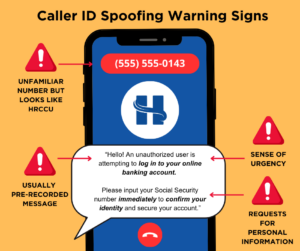
Spoofing calls are the first type of scam we want to highlight. Spoofing calls are the most common financial scam we have experienced at HRCCU. However, this type of scam is not unique to HRCCU as spoofing is a common occurrence across many types of institutions. What is Spoofing?
“Spoofing is when a caller deliberately falsifies the information transmitted to your caller ID display to disguise their identity. Scammers often use neighbor spoofing so it appears that an incoming call is coming from a local number or spoof a number from a company or a government agency that you may already know and trust. If you answer, they use scam scripts to try to steal your money or valuable personal information, which can be used in fraudulent activity.” (Federal Communications Commission, FCC)
Now, what can you do to avoid spoofing phone calls?
Do not answer calls from any number you do not recognize. However, a spoofed number may look like a number you recognize. If you get a spoof call appearing to be from HRCCU and the caller begins by asking you a flurry of questions about your account, please hang up and call us back at 518-886-3400 to confirm the call came from HRCCU.
Social Media Scams

At HRCCU we have seen a few social media scams that we want our members to be on the lookout for. These scams are the Facebook Forex Trading Review scam, the Giveaway scam, Facebook Comment Section Profile scam, and the Direct Message scam.
Facebook Forex Trading Review Scam: These scams mention either staff or products that do not exist at HRCCU. HRCCU does not take down reviews for transparency purposes, so occasionally these fake reviews get posted on our facebook page and while they are often “positive” they are meant to dupe people into getting in on “the investment and trading opportunity of a lifetime.” Never email, call, or whatsapp these numbers. This is how they gain your personal information in order to scam you out of money.

The Giveaway Scam: Scammers will also use money or products to bait “winners” into clicking on malicious links or sharing personal information to reclaim their prize. These compromised credentials can then be used to gain access to personal accounts and extract money from their victims.

Facebook Comment Section Profile Scam: Sometimes seemingly innocuous Facebook comments will appear on real people’s reviews or in the comments of a real profile’s post. More often than not the profile will have a picture of a famous military officer and they will leave a flirtatious comment on a real profile tempting them to become friends on Facebook. Please take care if and when you get a comment like this on your post. DO NOT accept their friend request or request them as a friend as this is a spoofed profile.


Direct Message Scam: Facebook Messenger scams occur when fraudsters use the Messenger app to con Facebook users into sending money or gift cards, giving up personal information that could lead to identity theft, or clicking on malicious links.
Scammers often impersonate users by setting up look-alike Facebook profiles or taking over legitimate accounts in order to send phishing scam messages to their victims’ Facebook friends.
Scammers use Facebook Messenger because most people have Facebook friends with whom they’ve lost touch or never knew very well in the first place. This makes it easy to reach out and build trust before targeting victims with advanced social engineering tactics and phishing scams.
Romance Scams
Romance Scams are common and a truly heartbreaking scam that we see come through our fraud department on an occasional basis.
Romance scams target individuals seeking online companionship. Fraudsters create fake profiles on dating websites, social media platforms, apps, and form relationships with their victims. These scams can build over time, and the fraud may not be immediate. Sometimes scammers use love bombing, often professing their love and affection, to gain trust. Once trust has been established, they may request money for various reasons, such as medical emergencies or travel expenses.
To avoid falling for a romance scam, be cautious when interacting with individuals online, never send money to someone you haven’t met in person and consider conducting a background check if you have suspicions. It can also be a good idea to research your scenario online since scammers often use the same playbook, so it is likely other people may have had a similar experience.
Phishing and Smishing
As referenced above: Phishing is a fraudulent attempt to obtain sensitive information such as usernames, passwords, and credit card details by disguising as a trustworthy entity in electronic communication such as an email or website, utilizing clickable links.
Smishing is very similar to phishing, but comes in the form of short messages/SMS otherwise known as text messages sent to your device. Smishing is a social engineering attack that uses fake mobile text messages to trick people into downloading malware, sharing sensitive information or sending money to cybercriminals. These scams appear to be from legitimate organizations. For example, these scammers can appear as banks, government agencies, or other trusted businesses. They may ask you to click on a link or provide personal information, which can then be used to commit identity theft or financial fraud. Examples of this that HRCCU has seen are messages from someone claiming to be the USPS and/or UPS informing you of a missed package delivery.
To protect yourself, always verify the legitimacy of the sender and do not click on suspicious links. We would also suggest you verify phone numbers and immediately block or report the message in your phone’s text messaging app settings.
Crypto Investment Scams
Cryptocurrency Investment scams often promise you can “make lots of money” with “zero risk,” and often start on social media or online dating apps/sites. These scams can also start with an unexpected text, email or call. With investment scams, cryptocurrency can be both the investment and the payment.
Here are some common investment scams and how to spot them:
A so-called “investment manager” contacts you out of the blue. They promise to grow your money, but only if you buy cryptocurrency and transfer it into their online account. The investment website they steer you to looks real, but it’s really fake, and so are their promises. If you log in to your “investment account,” you won’t be able to withdraw your money at all or only if you pay high fees.
A scammer pretends to be a celebrity who can multiply any cryptocurrency you send them. But celebrities aren’t contacting you through social media. It’s a scammer. And if you click on an unexpected link they send or send cryptocurrency to a so-called celebrity’s QR code, that money will go straight to a scammer and it’ll be gone.
The “Pay Yourself” Zelle Scam
Although we do not offer Zelle at this time, you may have access to Zelle through another institution and we want you to be aware of the “Pay Yourself” scam.
“The Pay Yourself Scam begins with a text message from a scammer that looks like a fraud alert from your bank. If you respond to the text message and engage the scammer, you’ll receive a call from a number that appears to be your bank. The scammer pretends to be a representative from your bank or credit union and offers to stop the alleged fraud. The scammer is actually tricking you into sending money to their own bank account.”
Here’s how they scam you:
“When you enroll with Zelle®, your bank sends you a security code to verify your identity. The scammer lies that they need this passcode to authorize your payment to yourself. If the scammer is given the one-time passcode, they’ll be able to enroll THEIR bank account with Zelle® using your email or phone number. Now the money you thought you were sending to yourself is sent directly to their bank account.”
Your bank will never ask you to send money to yourself, a person, phone number, or email that you do not know.

Arrest Warrant Scams
The Arrest Warrant Scam involves a scammer impersonating a variety of law enforcement agencies. We want our members to be aware that scammers can also manipulate caller ID (spoofing calls are mentioned at the beginning of this article) to make the number appear to come from the local law enforcement, the sheriff’s office or 911. The caller tells the person there is a warrant out for their arrest for a certain amount of fine. The reason for the warrant is represented as being anything from a traffic violation, missed jury duty, failure to pay full income tax requirements to the Internal Revenue Service, or some other minor infraction.
The scammer then tells the potential victim that their options are either to surrender themselves to the Sheriff’s Office for arrest or that they may pay a “reduced” payment of the fine to adjudicate the warrant.
The scammer provides instruction on how the payment should be submitted, usually through an “eGift” cash card or similar payment to a specified account or name given by the caller. These scam artists use pre-paid phones and many times are not even in the jurisdiction where the crime occurred, making their apprehension difficult.
Remember, the Sheriff’s Office will never ask for payment over the phone or offer to negotiate for reduced payment in lieu of arrest. Anyone with questions about a warrant may call the courts or local law enforcement.
The Amazon Scam
Since Amazon is used by a majority of Americans, it is important to be wary of common Amazon scams such as suspicious or fraudulent emails, text messages, or web pages. These emails or messages that do not come from Amazon may contain:
- Prompts to install software on your device.
- Typos or grammatical errors.
- Links to websites that look like Amazon.com, but aren’t Amazon.
- An order confirmation for an item you didn’t purchase or an attachment to an order confirmation.
- Forged email addresses to make it look like the email is coming from Amazon.com.
Extended Warranty Scams
Americans received over 70 billion unwanted robocalls in 2022, according to a study by Transaction Network Services.
Keep in mind that the best extended car warranty companies typically have dedicated customer service lines and won’t pressure you into providing personal information during a phone call.
Key Takeaways:
- Scam calls usually start with a prerecorded message asking you to press a button to speak with a company representative.
- Never provide any personal information over the phone.
- If you receive a scam call, report the number to the Federal Communications Commission (FCC).
Tech Support Scams
Tech support scams involve fraudsters posing as technical support representatives from reputable companies, such as Microsoft or Apple, claiming that your computer has been infected with a virus or malware.
They may then offer to fix the problem for a fee or ask for remote access to your computer, allowing them to steal sensitive information or install malicious software. Remember that legitimate tech support representatives will never cold call you or ask for remote access to your computer without your consent.
If you receive such a call, hang up immediately report it to the FCC.
This is a reminder that HRCCU will never contact you to ask for sensitive account information including online banking credentials. If you receive such a call, hang up and call us at 518-886-3400 to confirm the call was legitimate.
About HRCCU
Headquartered in Corinth, NY with four full-service branches from Glens Falls to Cohoes, HRCCU is a state-chartered financial institution with more than 33,000 members and $336 million in assets. Anyone who lives, works, worships, or attends school located within Saratoga, Warren, Washington, Rensselaer counties or the Towns of Cohoes, Watervliet or Green Island and their immediate families are eligible to join.
